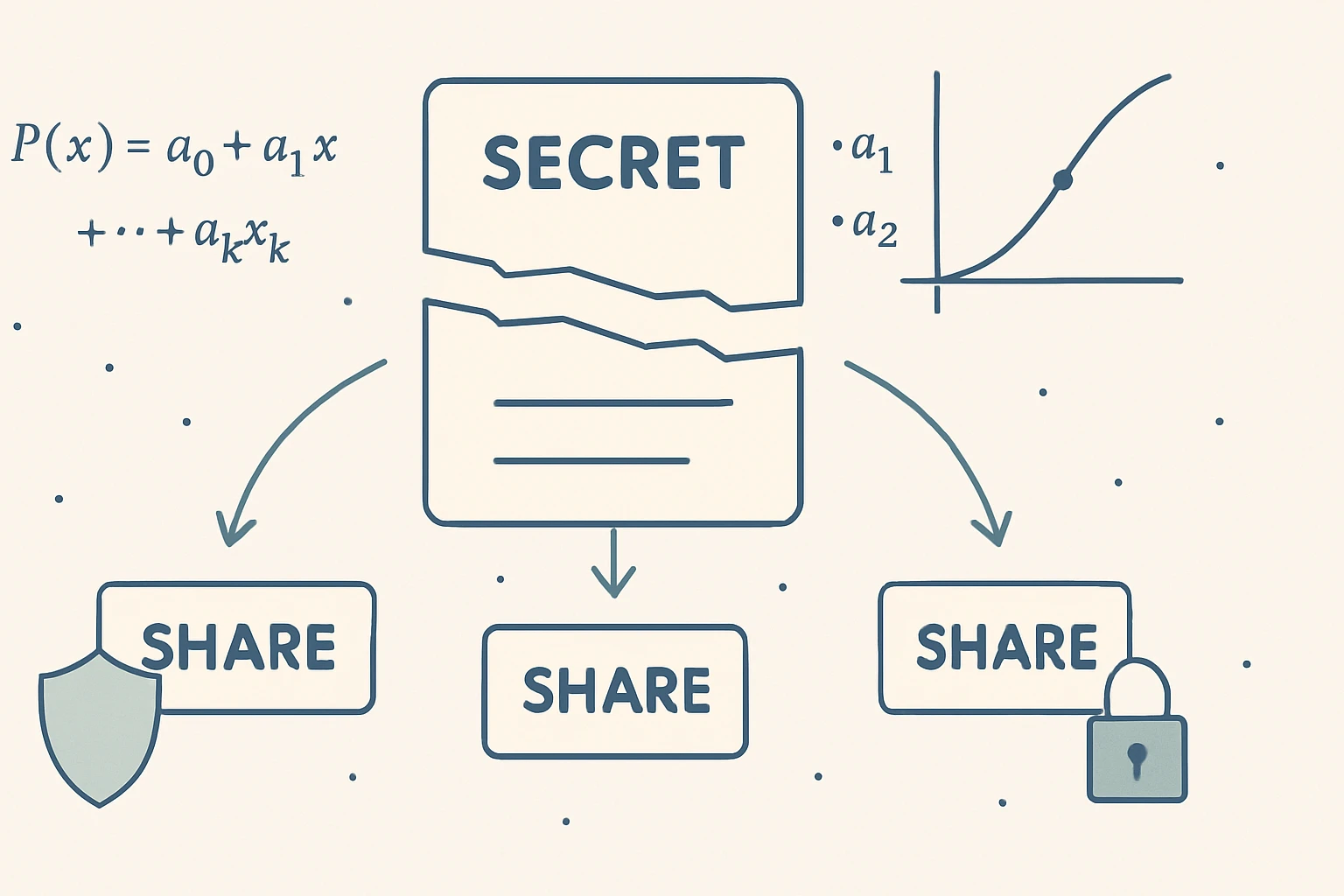
TL;DR: Inspired by Atomic Habits' principle of making bad habits harder, this post uses Shamir's Secret Sharing to fight doom scrolling addiction. The idea: split your Pi-hole admin password into 8 shares hidden across digital and physical locations, requiring any 4 to reconstruct the original. Each individual share reveals nothing. The post explains the cryptographic algorithm (polynomial interpolation over finite fields), walks through practical usage with code examples, and shares creative ideas for where to hide your shares.

I had a problem. I kept turning off my PiHole's social media blocking to mindlessly scroll through feeds. It was too easy - just login to the admin panel, disable restrictions, and boom - instant access to my time-wasting websites.
After reading Atomic Habits, I realized I needed to make bad habits harder to do. That's when I discovered Shamir's Secret Sharing scheme - a cryptographic technique that lets you split a secret into multiple pieces where you only need some of them to reconstruct it.
My solution? Split my PiHole admin password into 8 chunks and hide them across different digital and physical locations. Now when I want to disable restrictions, I need to really think about whether it's worth the effort of collecting 4 pieces.
What is Shamir's Secret Sharing?
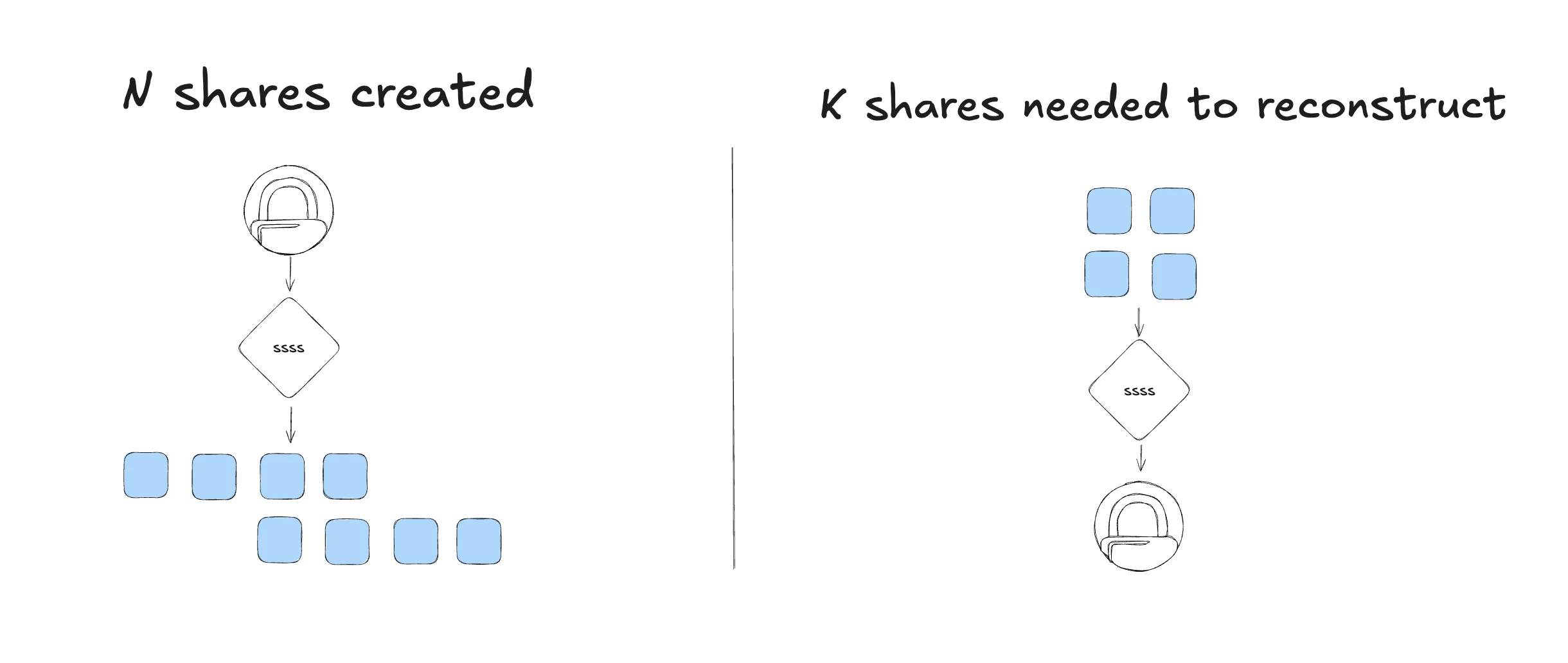
Shamir's Secret Sharing is a cryptographic algorithm that divides a secret into N shares, where any K shares can reconstruct the original secret, but K-1 or fewer shares reveal nothing about the secret.
Adi Shamir described it in his 1979 paper, How to Share a Secret:
"In this paper we show how to divide data D into n pieces in such a way that D is easily reconstructable from any k pieces, but even complete knowledge of k - 1 pieces reveals absolutely no information about D." — Communications of the ACM, 1979
The beauty is in the mathematics - it uses polynomial interpolation over finite fields. But you don't need to understand the math to use it effectively.
How does it work in practice?
Let's say you want to split your master password into 8 shares, requiring any 4 shares to reconstruct it:
With 8 shares and a threshold of 4, there are 70 different groups of 4 shares that can rebuild the password (8 choose 4 = 70). You can lose up to 4 shares and still recover it.
- Split Phase: Your password gets converted into shares like
1-abc123def456 - Distribution: You store each share in different locations or give them to different people
- Recovery: When you need the password, collect any 4 shares and reconstruct the original
The key insight: each individual share is completely useless. Someone with 3 shares has exactly the same information as someone with 0 shares.
Building a Practical Tool
I built a simple bash implementation that uses the ssss (Shamir's Secret Sharing Scheme) library. Here's how it works:
Installation
# macOS
brew install ssss

# Linux
sudo apt install ssss
Split a Password
# Use the unified CLI tool
./shamir.sh split
This prompts you to enter your password (hidden input) and generates 8 shares like:
1-abcd1234efgh5678
2-ijkl9012mnop3456
3-qrst7890uvwx1234
4-yzab5678cdef9012
5-ghij3456klmn7890
6-opqr1234stuv5678
7-wxyz9012abcd3456
8-efgh7890ijkl1234
Reconstruct the Password
# Use the unified CLI tool
./shamir.sh reconstruct
The reconstruction script has a nice ritual-like interface:
🔐 Password Reconstruction Ritual 🔐
====================================

Preparing to unlock your secret...
I need exactly 4 shares to proceed.

🔑 Enter share 1/4: 2-ijkl9012mnop3456
   ✓ Share 1 accepted
🔑 Enter share 2/4: 5-ghij3456klmn7890
   ✓ Share 2 accepted
🔑 Enter share 3/4: 7-wxyz9012abcd3456
   ✓ Share 3 accepted
🔑 Enter share 4/4: 1-abcd1234efgh5678
   ✓ Share 4 accepted

🔮 Combining the fragments...
   Invoking ancient mathematics...
   Reconstructing the secret...

🎉 SUCCESS! 🎉
==============

Your password has been revealed:
🔓 [your original password] 🔓
Real-World Use Cases
Breaking Bad Habits (My Use Case) Split your PiHole admin password to make social media access harder. Store shares in different locations - some in password managers, others as physical notes. The friction of collecting shares makes you reconsider impulse decisions.
Team Password Management Split critical system passwords among team leads. No single person can access production, but any 3 out of 5 leads can recover passwords during emergencies.
Personal Backup Strategy Store shares in different locations: cloud storage, physical notes, trusted family members. Even if you lose access to some shares, you can still recover your passwords.
Corporate Compliance Meet security requirements that mandate multiple approvals for sensitive access. The cryptographic guarantee means you can't cheat the system.
Security Considerations
Distribution Strategy
- Never store all shares together - defeats the entire purpose
- Different storage methods - mix digital and physical storage
- Geographic distribution - store shares in different locations
- Access control - limit who has access to each share
Threat Model
- Insider threats: Even malicious insiders can't access secrets with insufficient shares
- Data breaches: Compromising one storage location doesn't reveal the secret
- Key person risk: System doesn't break if some people leave or become unavailable
Advanced Features
You can customize the scheme for different security needs:
# High security: 10 shares, need 7 to reconstruct
echo "$PASSWORD" | ssss-split -t 7 -n 10

# Lower threshold: 6 shares, need 2 to reconstruct
echo "$PASSWORD" | ssss-split -t 2 -n 6

# Enterprise: 15 shares, need 8 to reconstruct
echo "$PASSWORD" | ssss-split -t 8 -n 15
What mistakes should I avoid?
Storing shares together - I've seen people save all shares in the same password manager. This completely defeats the purpose.
Not testing reconstruction - Always verify you can reconstruct your secret before relying on the shares.
Ignoring share protection - Each share should be stored securely. They're not the original secret, but they're still sensitive.
Poor documentation - Keep track of which shares you have and where they're stored, otherwise recovery becomes impossible.
Implementation Tips
- Start simple - Begin with a (4,8) scheme (4 needed, 8 total) for most use cases
- Test thoroughly - Always verify reconstruction works before deploying
- Document everything - Keep clear records of your sharing scheme
- Regular audits - Periodically verify you can still access your shares
- Have a backup plan - Consider multiple sharing schemes for critical secrets
Conclusion
Shamir's Secret Sharing solves a fundamental problem in security: how to protect secrets while ensuring availability. It's not just theoretical cryptography - it's a practical tool that can improve your security posture immediately.
The beauty is in its simplicity once implemented. You get mathematical guarantees about security while solving real business problems around access control and availability.
Whether you're breaking bad habits like I did with social media, managing team passwords, backing up personal credentials, or meeting enterprise compliance requirements, Shamir's Secret Sharing provides an elegant solution that balances security with practicality.

Frequently Asked Questions
What happens if I lose some shares?
You can still recover the secret as long as you have at least K shares. With a (4, 8) scheme you can lose any 4 shares.
How do I choose the threshold K?
Balance safety and convenience. A higher K means an attacker needs more shares, but you also need more shares to recover. For personal use, K at about half of N is a good start.
Is Shamir's Secret Sharing used in real products?
Yes. HashiCorp Vault uses it to protect its root key. By default, Vault splits the unseal key into 5 shares and needs any 3 of them to unseal.
Resources
- Complete Implementation - Ready-to-use bash scripts
- ssss in details - Core implementation details
- Technical Paper - Original Shamir paper
- Adi Shamir: How to Share a Secret (ACM Digital Library)
- ssss: Shamir's Secret Sharing Scheme tool
- HashiCorp Vault: Seal/Unseal concepts